


I want a meeting to take up less space in my head after it ends.
The recording can be saved, the transcript searchable, the summary sitting in my inbox, and I can still have a question hanging over me: what am I supposed to do with all this? I can look up what somebody said. Working out what we have actually agreed to takes more thought. Sending the transcript to a colleague passes that unfinished work along with it.
That is the part I want a brief to resolve. When I imagine receiving one, I want enough context to begin without having to reconstruct the meeting first. And if I cannot begin yet, I want to know whose answer I am waiting for.
Consider a hypothetical proposal meeting. Someone asks, “Could we send it on Friday?” Later, a colleague points out that pricing still needs approval. There are other things on the agenda, so the conversation moves on without anyone agreeing to arrange that approval.
The follow-up arrives: “Send the proposal on Friday.”
I can see how that sentence could survive a quick review. Friday was mentioned. Sending the proposal was discussed. Read against the conversation, though, the instruction asks somebody to proceed with pricing that has not been approved. The recipient now has to find the approver, establish whether Friday is possible, and probably come back with questions. Those questions were already there when the brief was written.
So the first thing I look for in a transcript is a commitment I can point to. “Could we” leaves room for an answer. “Once pricing is approved” makes the work conditional. I want to keep those qualifications close to the proposed action; otherwise, someone skimming the brief could reasonably mistake a possible date for a deadline.
For that meeting, my notes would look more like this:
- Suggested: send the proposal on Friday.
- Required first: get pricing approved.
- Still unanswered: who will arrange the approval?
At this point, asking for a shorter summary would leave me with the same missing answer. I need to find out who will arrange the approval.
I also have to be careful with my own notes. Suppose I record “I think Friday would work” after the call. That may be useful context, especially if I explain why. It still does not establish that everyone agreed. My confidence about a decision is not evidence that the decision was made. If I combine a personal reflection with the transcript, I want its source to remain visible while I review the material.
This gives me a fairly specific job to ask an AI assistant to do: pull out the commitments and conditions, show me the passages behind them, and flag what it cannot establish. I can then check those passages against the recording or ask the speaker. If two people appear to give different dates, I need to see both. Choosing the later mention automatically could hide a disagreement that nobody resolved.
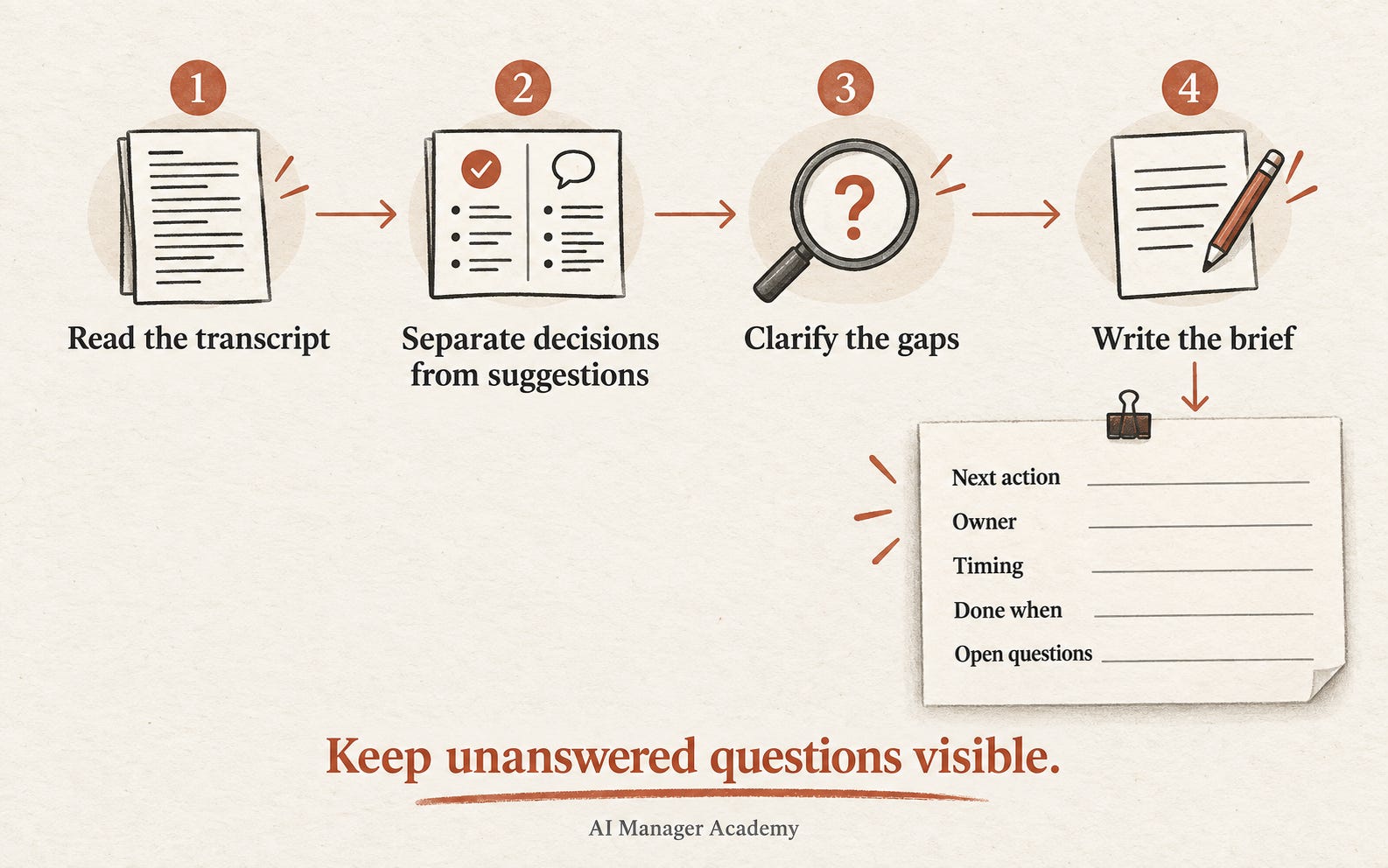
There is a limit to how much clarification is useful. A meeting may contain a dozen loose ends, and I don’t want to delay a straightforward task while I tidy up all of them. I ask which unanswered question could change the work in front of us. Someone might be able to format the proposal while pricing is under review. Sending it to the client still has to wait. The brief should make that boundary clear.
For the proposal, my immediate questions are who can approve pricing and who will get that answer. Friday can be checked against that dependency. Here is what I could put in a brief before the answers arrive:
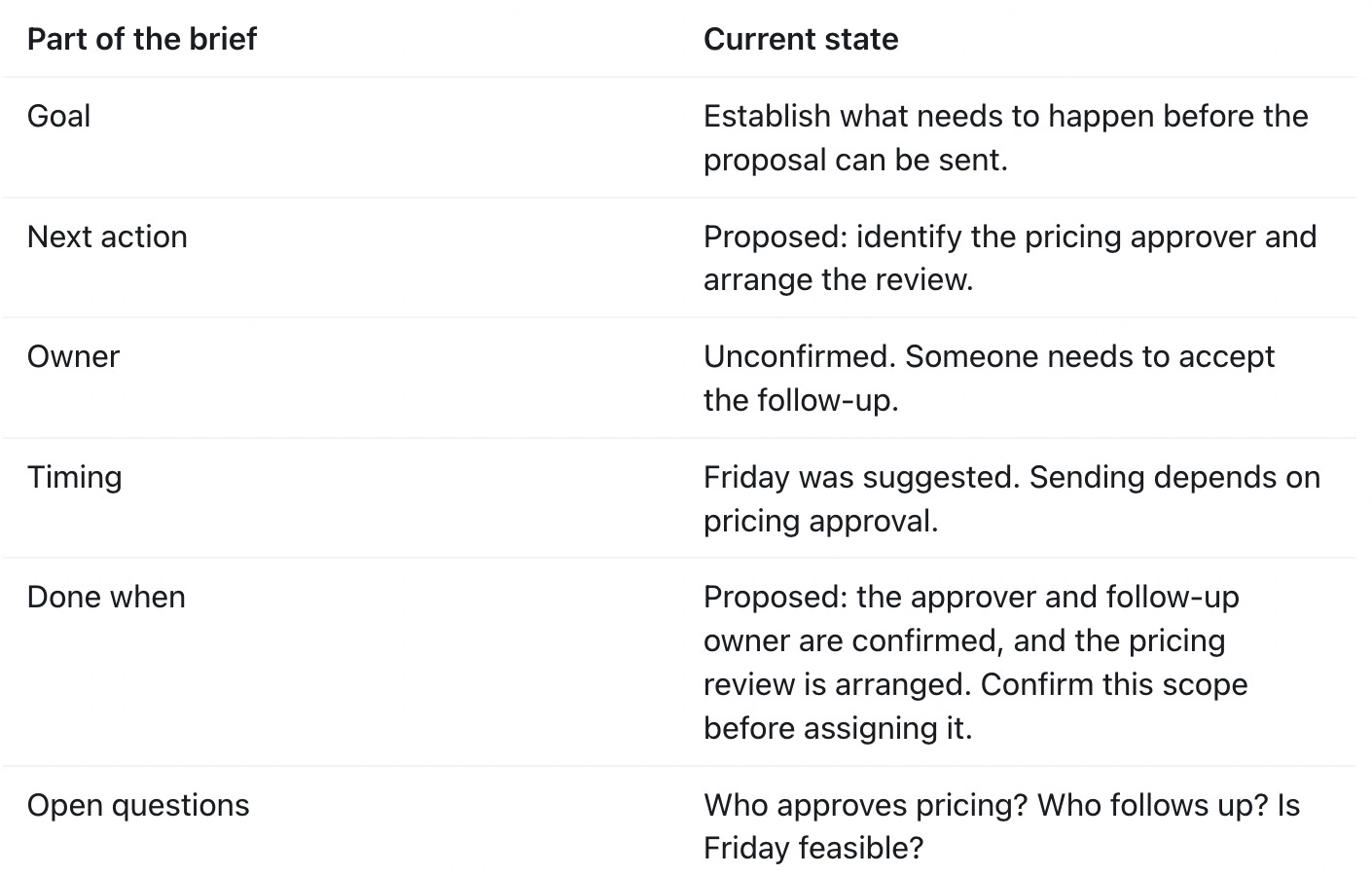
The empty ownership field bothers me because it means I have another follow-up to make. Filling it with the most likely person’s name would be easy. But being mentioned in a conversation, knowing the client, or having done a similar task before does not tell me whether that person has accepted this one. An unconfirmed owner is a question I still owe the team an answer to. This version of the brief is ready for clarification.
Let’s continue the hypothetical example. The follow-up gets pricing approved. The account lead agrees to send the proposal by Friday at noon and record delivery in the project notes. With those answers, the brief can become an instruction:
“Update the proposal with the approved pricing and send it to the client by Friday at noon. The account lead owns this. The work is complete when the correct proposal has been sent and delivery recorded in the project notes.”
There is no need to retell the whole discussion here. I would include a reference to the approved pricing so the account lead can find it, along with any constraint that affects sending. The brief now covers a different piece of work from the earlier table: we have finished arranging approval and can hand over the sending task.
I prefer to make two requests of the AI assistant, with my review between them. First, extract what the conversation supports and what needs an answer. Once I have checked that material and supplied the missing decisions, draft the brief. I need to resolve the uncertainty before I ask for wording that sounds settled. Otherwise I am reviewing an entire plan while trying to remember which parts were ever agreed.
I’ve put the worksheet and both prompts here. For a design review, the missing answer might be which version someone is meant to revise. For an event, it might be whether the venue has been booked. The fields are useful only if they expose the particular thing that could trip up the person doing the work.
Before sharing it, I read it as someone who missed the meeting:
- Action: can I tell what to do first?
- Owner: has someone accepted responsibility?
- Timing: do I know the deadline and what has to happen beforehand?
- Completion: can I tell when the work is finished?
I leave any remaining question beside the action it affects. I also remove context that the recipient does not need. My private reaction to a discussion may have helped me think it through; the colleague receiving the brief usually needs the agreed decision and a way to check it.
For your next meeting, try this with one piece of work. Put the action, owner, timing, and completion condition in a few lines. Mark what nobody actually agreed to. You may already have enough for someone to begin. Or you may discover that the most useful thing you can do is ask one person a question.
That is the relief I want from the process. When I close the notes, I want to know what happens next and who has agreed to do it. If something is still waiting on me, I want it written where I can see it.