A common way of thinking about prompting is that you need to learn how to ask AI correctly. If the answer is weak, perhaps the wording was too vague or you missed an instruction. The solution is to find a better prompt.
This is the understanding behind a search for “the best prompt for a strategy presentation” or a saved collection of prompts for managerial tasks. You learn to assign AI a role, provide background and describe the answer you want. A successful prompt becomes something to reuse.
There is useful advice in this approach. AI needs information about what you are asking it to do, and different instructions can produce different results. But learning to prompt involves a difficulty that a collection of instructions does not resolve: you may not yet know exactly what to ask for.
How prompting has changed
The emphasis on prompt techniques had a basis. OpenAI's September 2022 guide discussed ways to improve model performance by changing how a task was presented. One technique was to ask the model to work through an answer step by step. The guide also noted that the benefit depended on the task. OpenAI's 2022 guide.
For its reasoning models, which are designed to perform additional reasoning before producing an answer, OpenAI recommends simple, direct instructions. It says that asking these models to “think step by step” is unnecessary and can sometimes hinder performance. A technique that helped with an earlier model is therefore something to reconsider when the model changes. OpenAI's reasoning-model guidance.
The way AI is used has also expanded. In work that continues across several exchanges, the first prompt is only part of what shapes the result. The model may also receive documents and earlier responses. Where tools are available, their results become part of the information it works with.
Anthropic describes the work of selecting and maintaining this information as context engineering. Its September 2025 explanation distinguishes writing instructions from managing the wider information available to a model during an ongoing task. Anthropic on context engineering.
For a manager, this changes the practical problem. A carefully worded request can still produce a poor answer if it refers to an outdated policy or leaves out a decision made in an earlier meeting. Adding more material may create another problem if the model cannot distinguish the current policy from an old draft. You need to decide which information belongs in the work and what status it has.
As a manager, your work with AI therefore involves choices that continue after the first instruction. As the work develops, you may discover that the task needs different evidence or that your initial request does not address the real problem.
What people get right, and what they miss
The standard advice is to make your requirements explicit. If you know who the answer is for or what evidence it must use, telling AI helps. An example can clarify the kind of answer you need. A required format can make the result easier to use.
The practical difficulty is that the requirements themselves may be unclear. You know you need a strategy presentation, but you have not worked out which comparisons the leadership team needs. You know a project report needs attention, but you are unsure what information would establish whether to intervene.
Thinking through every requirement before involving AI can become a substantial task of its own. It also asks you to anticipate details that may become apparent only when you examine the material. The advice to be explicit is useful when you know what matters. You also need a way to discover what matters while doing the work.
An AI-generated list of requirements does not settle this automatically. It could suggest a conventional presentation structure when your meeting requires a particular decision. You need some basis for judging which suggestions are relevant.
There is a related problem with the task you select. You can specify it clearly while leaving the reason for choosing it unexamined.
Suppose sales conversion has declined and you ask AI to write a motivational message to the team. You specify an encouraging tone and a concise format. AI may produce a message that meets both requirements.
But your request has already assumed that motivation is a useful problem to address. If the decline comes from poor lead quality or delays in approving proposals, a better-written message will do little to resolve it. The important revision would be to examine the explanation for the decline before deciding what to communicate.
The same issue appears when you review an answer. A response can satisfy the requested format while leaving the intended decision unresolved. If you judge it mainly by how complete or professional it looks, you are missing the gap.
This is why managers need a mental model of prompting that includes how their own understanding develops. The conversation can help you discover requirements and examine your initial interpretation. You need a way to direct that discovery and judge whether it is helping.
The thinking you need to monitor
When you ask why you selected a task, or notice that its result does not help, you are examining your own approach to the work. Changing the approach in response is part of metacognition, the ability to examine and regulate your cognitive activity.
Applied to prompting, this gives you a way to understand the conversation. You can begin with an incomplete understanding and use AI to help develop it. You monitor whether the approach is clarifying what matters. If it is not, you can change the question or obtain different evidence.
In the sales example, recognising that a motivational message assumes a cause you have not established is monitoring. Asking AI to help examine alternative explanations changes the approach. That is control.
A small habit: think one level above the output
You do not need to turn this into an elaborate reflection exercise. Before asking AI for something, think one level above the output you want.
Ask:
If AI gave me exactly what I asked for, what would I use it to accomplish?
Then include that purpose in your request. If it still leaves you unsure what matters, ask the same question about it and move one level higher. Stop when you can name the concrete decision or action that the output should support.
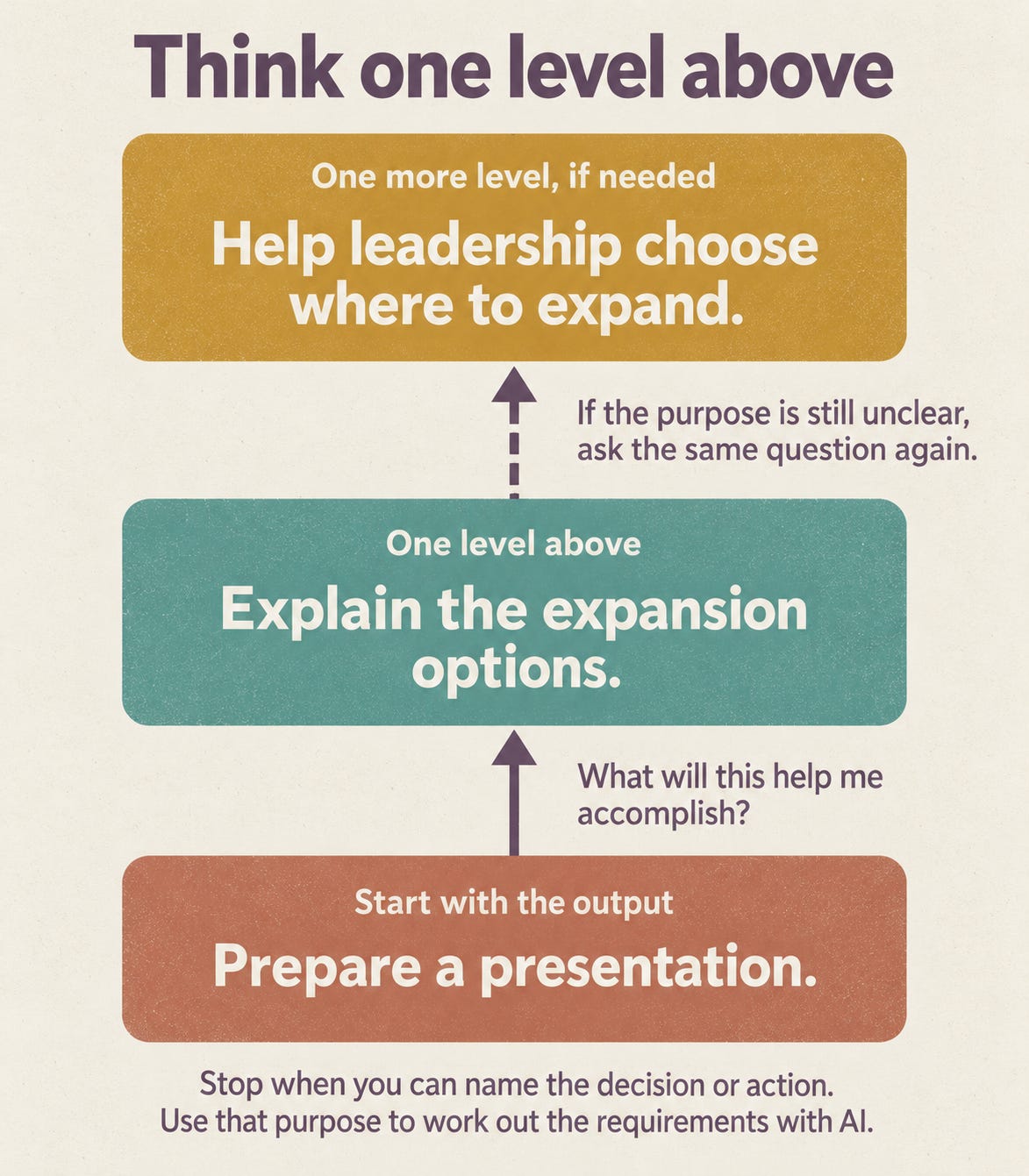
There is a general thinking theory that helps explain this mechanism. Action identification theory, developed by Robin Vallacher and Daniel Wegner, describes how the same action can be understood at different levels. A lower-level description concerns how the action is performed; a higher-level description concerns its purpose or effects. Their 1987 paper also explains why difficulty can require a return to the details of execution. Vallacher and Wegner, 1987.
For prompting, the practical application is to identify the nearest concrete use of the requested output. Preparing slides is an activity. Enabling a choice between expansion options identifies what the slides need to support. That purpose can guide what belongs in them and how you assess the result.
“Help the business succeed” is too abstract to do this. It gives little direction about what a presentation must contain. You can stop at the immediate decision or action, while still specifying details that the work requires.
This gives AI a basis for helping you discover the requirements. For the presentation, you could ask:
The leadership team needs to choose between these expansion options. Help me identify what they need to compare, using the material I have provided, and flag the information still missing.
You can judge the suggested comparisons by whether they help with that choice. You do not have to design the whole presentation before asking for help. The purpose guides the discovery of requirements as the work develops.
If even the purpose is uncertain, describe the situation and ask what decisions or actions the output could support. AI can help you clarify that too. You can begin the conversation before you have a complete plan. If you liked this, feel free to share this post and subscribe.