


It happened mid-call, when a senior engineer asked me to justify a memory-layer design I had “figured out” three weeks earlier. I reached for the reasoning and it was not there. What was there was a reflex: open the tool, search the note, read it back. The design lived in my system. It did not live in me. For a few seconds in front of someone whose opinion mattered, I was the engineer who can’t defend his own architecture.
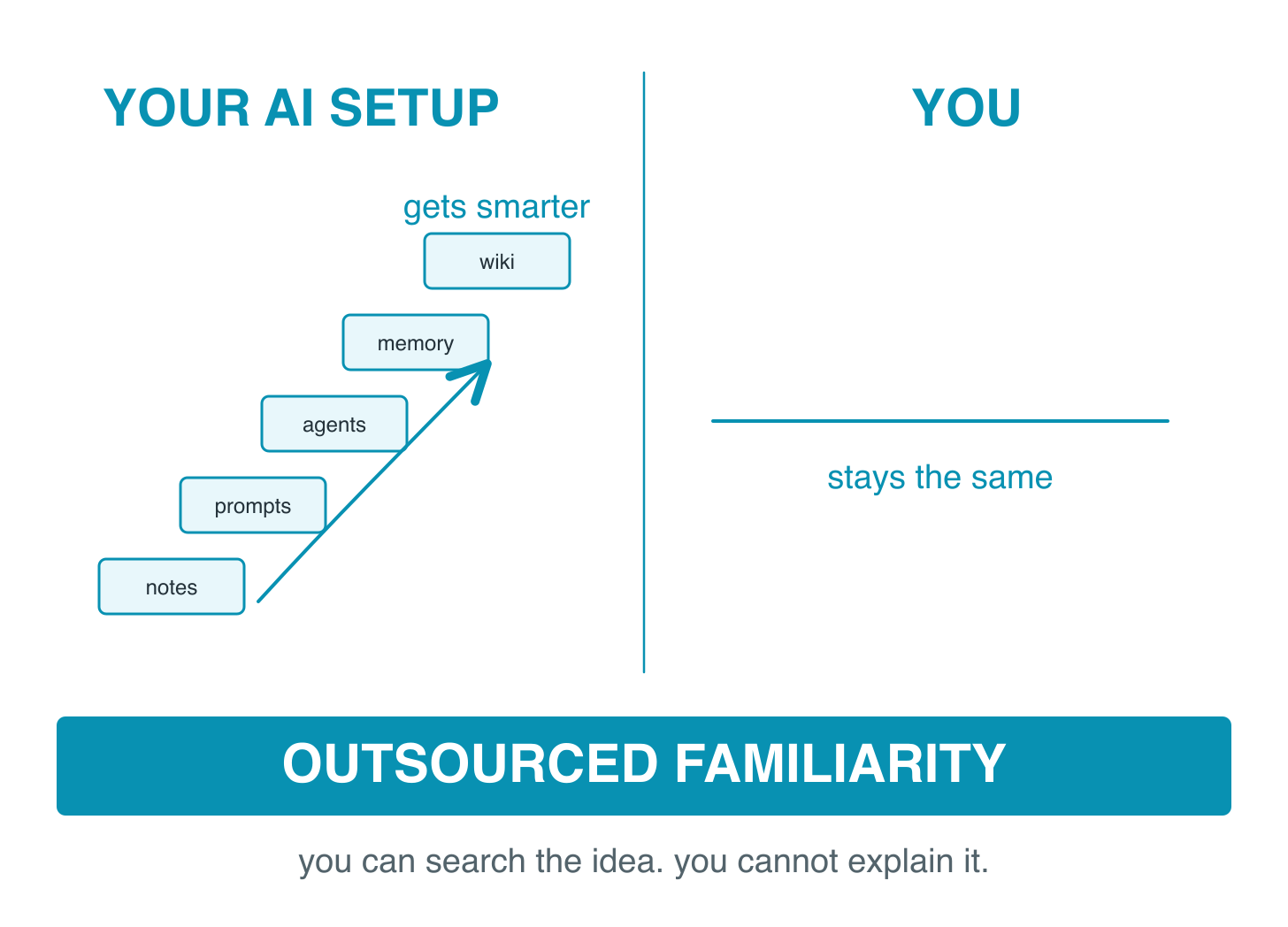
That gap has a name now. Outsourced familiarity: the state where your external setup keeps getting more capable while the thing between your ears stays exactly where it was. You can retrieve the idea. You cannot reconstruct it. And the gap is invisible right up until the moment it costs you, a design review, a system-design interview, a production incident where the tool can’t think fast enough and you have to.
If you’ve spent the last year wiring up prompts, MCP servers, agent workflows, and a beautiful note graph, this is the specific failure that setup hides, and the reason it quietly caps how senior you can get.
The setup gets smarter, the engineer does not
Here is the uncomfortable version. A capable AI stack summarizes everything you read, drafts your code, writes your wiki, generates your diagrams, and hands you tidy takeaways. At the end you have an artifact trail that looks like senior work. The judgment that was supposed to come with it never got built.
I lived inside this for months and mistook it for leveling up. The library kept growing. The retrieval kept improving. The tags got cleaner. From the outside it was indistinguishable from getting better. From the inside it was hoarding with better search.
It’s hard to catch because the tool’s output is genuinely good. The summary is accurate. The generated handler runs. The note graph surfaces the right source. Nothing is broken, which is exactly why nothing warns you. The judgment you wanted, knowing which design is right and why, quietly never formed, because the tool produced the answer before you had to.
There’s a real mechanism underneath this, and it’s worth knowing because it tells you where the tool is safe and where it’s costing you. Struggling to produce an answer is what consolidates it. Retrieval practice, the effortful pull from memory, is one of the most replicated findings in learning research, and the effort is the point. When a tool removes the effort, it removes the consolidation with it. You feel fluent because you just read a clean explanation. Fluency on reading is not the ability to generate under pressure, and the gap only shows up later, in the review, the interview, the incident, with the tool closed.
Why the usual fixes do not touch it
The instinct, once you notice the gap, is to add more system. Better tags. A weekly review ritual. A smarter retrieval setup. A second memory layer that summarizes the first.
None of that helps, because every one of those fixes lives on the storage side of the problem. The gap is not in your system. The gap is in the handoff between your system and you. Improving the system makes the handoff worse, not better, because a more capable system has more reasons to do the encoding step on your behalf.
“Summarize this for me” is the cleanest example. It is a perfect instruction when the goal is lookup. It is a quietly damaging one when the goal is learning, because the summarizing is the learning. Hand it off and you get the artifact without the change in you.
So the question is not “how do I build a better system.” It is narrower and more annoying: Which exact cognitive step am I trying to keep, and is the tool stealing it?
The test: does the tool remove friction or remove thinking
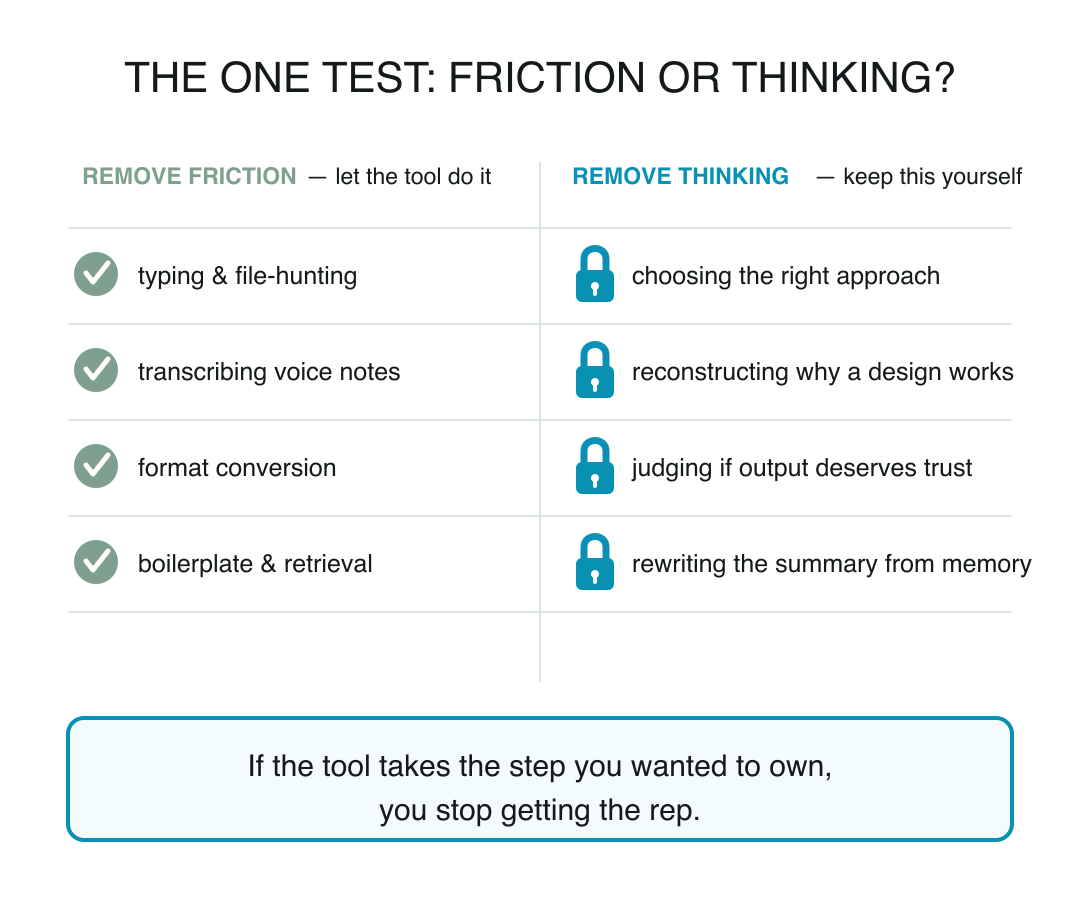
This is the single line I run everything through now. Friction or thinking.
A tool that removes friction takes away the parts that were never teaching you anything: the typing, the file-hunting, the transcription, the format conversion, the boilerplate. Take all of that. None of it builds judgment.
A tool that removes thinking takes away the step you specifically wanted to own: choosing which approach is right, reconstructing why a design works, deciding whether generated output deserves trust. The moment a tool does that step for you, you stop getting the rep.
In practice it splits like this. I let AI retrieve sources, cluster them, draft rough versions, compare options, transcribe voice notes. I do not let it own the step I am trying to strengthen. If I want recall, I rewrite the summary from memory before I look. If I want design judgment, I reconstruct the argument for the design before I read the explanation back. If I want to actually understand generated code, I read the handler and predict its behavior under retries, partial failure, concurrency, bad input, and stale state before I trust it.
The test is cheap to apply and it stings every time, because the steps worth keeping are exactly the ones the tool is best at taking.
What this looks like when it bites
The clearest case for me was a cross-client memory design. I had it “solved,” meaning I had a thorough note and a working reference the AI had helped me produce. When I had to defend the design live, I could quote it and not derive it. The handoff had eaten the encoding. I had let the tool own the reasoning step and kept only the artifact.
The fix was not a better note. It was forcing the reconstruction: close everything, rebuild the argument from scratch, and only then compare against the saved version to find what I had actually missed. The first time I did this I missed about a third of my own reasoning. That third was the part I never encoded because the tool had encoded it for me.
It shows up in reading too. An agent-built wiki summarizing my sources beautifully was making my own recall weaker, not stronger, because the summarizing was the part that would have stuck. The version that works keeps me in the loop on the one step that matters: the AI suggests relationships between ideas, I confirm or reject each edge myself. The suggestion is friction removed. The confirmation is the thinking, kept.
Where this still breaks
It breaks under deadline. When something real is due, I let the tool take the thinking step because it is faster, and I ship. The difference now is only that I know which rep I just skipped and what it will cost me later. That is not a fix. It is honest debt.
It also fails as a vanity ritual. You can turn “keep the thinking step” into another aesthetic, a tidy rule on a dashboard you admire and never apply. The rule is worth nothing unless it changes a specific action: one summary you rewrite from memory, one design you reconstruct, one generated function you interrogate before trusting.
So the smallest real version is this. Take one thing your AI setup did for you today, a design, a summary, a generated handler. Redo that one step yourself, tool closed, before you look at its answer. If you can reproduce it, the judgment is yours. If you can’t, the tool owns it and you don’t, and you just found the exact gap that will surface in your next design review.
Do that a few times a week and the compounding flips. The engineers who stay valuable in an AI-saturated market aren’t the ones with the best stack. They’re the ones who can still derive the design, defend the trade-off, and catch the bug the model confidently shipped, because they kept the reps the tool was happy to take. That’s the difference between an engineer who uses AI and one who’s slowly being replaced by their own setup.
If outsourced familiarity has bitten you, in a review, an interview, an incident, reply and tell me where. I’m collecting the failure modes, and the sharpest ones come from people who felt it live.